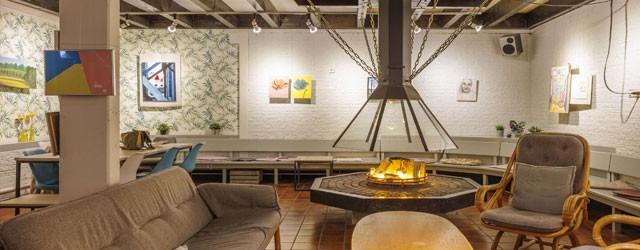
Tijdens de expositie in De Mannenzaal (2026) in samenwerking met Museum Amersfoort zijn vier interviews met hofjesbewoners te zien en te lezen, gemaakt door Rufus de Vries. Hier lees je het volledige interview met Evelien en Jelle. For English: please scroll down.
Evelien (67, schommel) woont al sinds 1998 in de Hof der Toekomst. "Destijds kwam ik hier met mijn man en onze vierjarige zoon," vertelt ze. "We wilden graag op een plek wonen waar hij veilig naar buiten kon en sociale vaardigheden makkelijk zou leren." Jelle (70, met slijptol) is later aangesloten. Hij kwam in 2003 wonen in de Hof der Toekomst.
De Hof der Toekomst is een cirkel van 62 woningen, gebouwd in 1993 onder de vlag van Centraal Wonen. Deze landelijke organisatie streeft naar een woonvorm waarbij bewoners bewust kiezen voor het delen van ruimtes en voorzieningen, naast hun eigen woning.
Dat uitgangspunt is in de Hof der Toekomst goed zichtbaar. Allereerst door de cirkelvorm, waarbij alle voordeuren uitkomen op de binnenhof – essentieel voor makkelijk contact, vinden Evelien en Jelle. Daarnaast zijn er twee woningen vrijgemaakt voor gemeenschappelijk gebruik. Daar vind je nu logeerkamers, een wasserij en, tijdelijk, een Oekraïens gezin. Ook is er een tuin met een cirkelvormig gebouw voor gemeenschappelijk gebruik. "Daar worden feestjes gehouden en vergaderingen van alle commissies die actief zijn," zegt Evelien. Jelle vult aan: "En zoals je ziet, kun je er ook gebruikmaken van de gemeenschappelijke werkplaats. Zo hoeft niet iedereen voor zichzelf gereedschap te kopen." De tuin wordt in eigen beheer onderhouden. Vijfenzeventig procent van de woningen is sociale huur; de overige 25% zijn koopwoningen. Die herken je vaak aan de dakopbouw.
Wat is nu het geheim van een goede hof? Jelle: "De beslotenheid. Je hebt wel toegang, maar er loopt geen weg doorheen. En heel belangrijk: de deuren zitten aan de binnenzijde van de hof." Een nadeel van het wonen in een hof kan ʻde democratieʼ zijn, aldus Evelien. "Ik bedoel: overal moet over gepraat worden. We hebben dat zelfs opgedeeld in praatavonden en besluitavonden."
Evelien: "We hebben ook overwogen om een zelfstandige wooncoöperatie te worden, zodat we gezamenlijk eigenaar zouden zijn en van de vereniging zouden huren. Maar dat is ontzettend ingewikkeld. Uiteindelijk praat je dan vaak alleen maar over geld. Daar heb ik in ieder geval geen zin in."
"Oh, en pubers vinden wonen in een hof verschrikkelijk," voegt ze toe. "Die willen zelfstandig worden en zich juist aan de gemeenschap onttrekken. Vaak kunnen ze het later weer waarderen. Dat merkte ik aan mijn zoon (die nu geen puber meer is): toen hij een vriendin rondleidde, hoorde ik hem allerlei dingen vertellen waar ik het zojuist ook over had."
During the exhibition at De Mannenzaal (2026), organised in collaboration with Museum Amersfoort, four interviews with residents of courtyards, conducted by Rufus de Vries, are on display and available to read. You can read the full interview with Evelien en Jelle here.
Evelien (67, swing) has lived in the Hof der Toekomst since 1998. “Back then, I moved here with my husband and our four-year-old son,” she explains. “We really wanted to live somewhere where he could play outside safely and learn social skills easily.” Jelle (70, with an angle grinder) joined the community later. He moved to Hof der Toekomst in 2003.
Hof der Toekomst is a circle of 62 homes, built in 1993 under the auspices of Centraal Wonen. This national organisation aims to create a form of housing in which residents consciously choose to share spaces and facilities, alongside their own homes.
That principle is clearly evident at Hof der Toekomst. Firstly, through the circular layout, where all front doors open onto the inner courtyard – essential for fostering easy social interaction, according to Evelien and Jelle. In addition, two homes have been set aside for communal use. These now house guest rooms, a laundry room and, temporarily, a Ukrainian family. There is also a garden with a circular building for communal use. “That’s where parties are held and meetings of all the active committees take place,” says Evelien. Jelle adds: “And as you can see, you can also make use of the communal workshop there. That way, not everyone has to buy their own tools.” The garden is maintained by the residents themselves. Seventy-five per cent of the homes are social housing; the remaining 25 per cent are owner-occupied. You can often tell the difference by the roof structure.
So what is the secret to a good courtyard? Jelle: “The sense of privacy. You do have access, but there’s no road running through it. And very importantly: the doors are on the inside of the courtyard.” One drawback of living in a courtyard can be ‘democracy’, according to Evelien. “I mean: everything has to be discussed. We’ve even split that into discussion evenings and decision-making evenings.”
Evelien: “We also considered becoming an independent housing co-operative, so that we’d be joint owners and rent from the association. But that’s incredibly complicated. In the end, you often end up talking about nothing but money. I certainly don’t fancy that.”
“Oh, and teenagers find living in a courtyard dreadful,” she adds. “They want to become independent and actually withdraw from the community. Often, they come to appreciate it again later on. I noticed that with my son (who isn’t a teenager any more): when he was showing a girlfriend round, I heard him saying all sorts of things that I’d just been talking about.”


 TIP
TIP