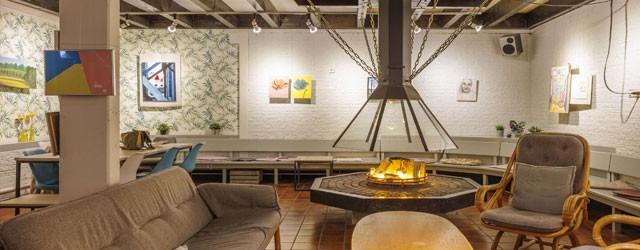
Tijdens de expositie in De Mannenzaal (2026) in samenwerking met Museum Amersfoort zijn vier interviews met hofjesbewoners te zien en te lezen, gemaakt door Rufus de Vries. Hier lees je het volledige interview met Harry. For English: please scroll down.
Rond 2008 werd dit complex bij het Julianaplein gebouwd. Harry (80) woont er sinds 2017, op de begane grond. "Kort na onze verhuizing hebben we samen met enkele buren, het initiatief genomen om de muurtjes open te breken voor een hekdeurtje naar de binnentuin" vertelt hij. "Dat had trouwens ook niet eerder gekund: de architect had bedongen dat het ontwerp de eerste tien jaar ongewijzigd moest blijven.
Door onze eigen ingreep gebruiken we onze voordeur amper nog. Gasten komen vaak via de binnentuin. De tuin en het aansluitende hofje zijn echt mijn plek. Ik zit hier vrijwel dagelijks: ik lees de krant, onderhoud mijn digitale contacten en heb ondertussen oog voor de buren. Toch kan ik me ook afsluiten, terwijl ik buiten blijf zitten. In tegenstelling tot mijn vrouw, die veel directer reageert op wat er om haar heen gebeurt. Ik ben dan ook degene die hierdoor het meest buiten zit."
Het treintje op het hofje wordt door kinderen van alle leeftijden gebruikt. Niet alleen jonge kinderen, ook pubers blijven er plezier in hebben om er op te zitten. Op het binnenterrein zijn meerdere uitgangen: naar de parkeergarages eronder – twee lagen diep – en naar de straat. Midden op het hofje staat een afvalcontainer. Daar staat, voor zover Harry weet, zelden iets naast. "Dat komt vast doordat zoveel mensen erop uitkijken. De container, de uitgangen van de parkeergarages, de pakketwagens die hier mogen rijden: ze dragen allemaal bij aan een prettige reuring."
Zijn vrouw herinnert zich nog het moment dat ze hier voor het eerst waren om de woning te bezichtigen. "Medebepalend was dat er toen iemand op het hofje zijn fiets aan het repareren was en er kinderen buiten speelden. Dat droeg bij aan het gevoel dat we hier wel zouden willen wonen."
Terwijl Harry dit vertelt, rijdt er pal langs zijn hekdeurtje een grote afvalwagen over het hofje om de container te legen. Bij de afvalcontainer verderop aan de straat staan juist regelmatig grote kartonnen dozen naast de container. Kennelijk maakt het uit waar zo’n afvalpunt staat.
"Het groen op het hofje is weldadig," gaat Harry verder. "Prachtige acaciabomen, afgewisseld met struiken die ’s winters groen blijven. In de zomer zitten mijn vrouw en ik vaak onder de bomen in het midden van het hofje, want dan wordt het op ons terras te warm."
During the exhibition at De Mannenzaal (2026), organised in collaboration with Museum Amersfoort, four interviews with residents of the courtyards, conducted by Rufus de Vries, are on display and available to read. You can read the full interview with Harry here.
This complex near Julianaplein was built around 2008. Harry (80) has lived there since 2017, on the ground floor. “Shortly after we moved in, we took the initiative, together with a few neighbours, to knock through the walls to create a small gate leading to the courtyard,” he explains. “That wouldn’t have been possible before, by the way: the architect had stipulated that the design had to remain unchanged for the first ten years.
Thanks to our own alterations, we hardly ever use our front door anymore. Guests often come in via the courtyard garden. The garden and the adjoining courtyard are really my spot. I sit here almost every day: I read the paper, keep in touch with people online and keep an eye on the neighbours at the same time. Yet I can also shut myself off, whilst still sitting outside. Unlike my wife, who reacts much more directly to what’s going on around her. That’s why I’m the one who spends the most time sitting outside.”
The little train in the courtyard is used by children of all ages. It’s not just young children; teenagers also continue to enjoy riding on it. There are several exits in the inner courtyard: to the underground car parks below – two levels deep – and to the street. In the middle of the courtyard stands a rubbish bin. As far as Harry knows, there’s rarely anything left next to it. “That’s surely because so many people look out onto it. The bin, the exits from the car parks, the delivery vans that’re allowed to drive here: they all contribute to a pleasant buzz.”
His wife still remembers the moment they first came here to view the property. “One of the deciding factors was that, at the time, someone was repairing their bike in the courtyard and there were children playing outside. That added to the feeling that we’d like to live here.”
As Harry tells this story, a large refuse lorry drives right past his gate into the courtyard to empty the bin. At the refuse bin further down the street, large cardboard boxes are regularly left next to it. It seems to make a difference where such a refuse point is located.
“The greenery in the courtyard is lovely,” Harry continues. “Beautiful acacia trees, interspersed with shrubs that stay green in winter. In summer, my wife and I often sit under the trees in the middle of the courtyard, because it gets too hot on our terrace.”


 TIP
TIP